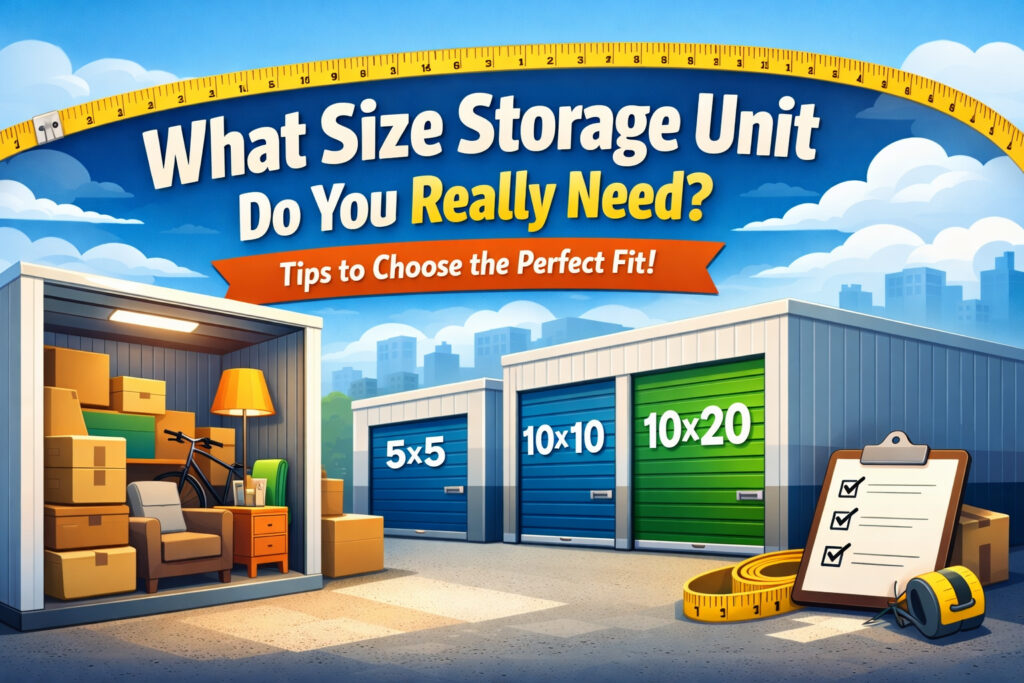
Why picking the right storage size matters more than most people think
Choosing the right storage unit is not just about finding empty space. It is really about balancing three things: cost, convenience, and protection. Rent too small, and you may end up cramming boxes into unsafe stacks or needing a second unit later. Rent too large, and you may pay month after month for square footage you never touch.
Most self-storage companies group units into small, medium, and large categories. Common sizes include 5×5, 5×10, 10×10, 10×15, 10×20, and 10×30. Small units are often compared to closet space, medium units are frequently used during moves or remodels, and large units are meant for whole-house storage or even some vehicles.
That means the smartest choice is not “the biggest unit you can afford.” It is the smallest unit that still lets you store items safely, access what you need, and protect belongings that matter.
What Size Storage Unit Do You Really Need? Start with a simple home inventory
Before you look at dimensions, make a fast inventory. This single step saves people the most money.
Start with the big pieces:
- sofas
- mattresses
- dressers
- dining tables
- desks
- appliances
- bikes
- shelving
Then count the smaller items:
- moving boxes
- bins
- lamps
- rugs
- mirrors
- office files
- holiday décor
Count furniture first, boxes second
Furniture eats floor space. Boxes eat air space. That is why two people with the same number of belongings may need different unit sizes. A person storing thirty stacked boxes might fit easily into a smaller unit. A person storing a sectional sofa, king bed, and large dining table may need much more room.
Measure bulky items before you reserve
Do not guess the size of your couch or mattress. Measure length, width, and height. Pay special attention to oddly shaped pieces like L-shaped sectionals, armoires, treadmills, and patio sets. Even when the total square footage looks fine on paper, awkward shapes can change everything.
A good rule of thumb is to think in layers:
- Floor space for large items.
- Vertical stacking for strong boxes and bins.
- Walking space so you can reach items without unpacking half the unit.
How storage unit sizes are usually grouped
Storage companies commonly describe sizes in broad groups. Extra Space Storage lists small sizes like 5×5 and 5×10, medium sizes like 10×10 and 10×15, and large sizes such as 10×20, 10×25, and 10×30. U-Haul similarly groups smaller units as closet-like overflow options and larger units as better fits for full household storage.
Small units for light overflow storage
Small units are ideal when you need extra breathing room, not a full second garage. They work well for boxes, holiday decorations, off-season clothes, books, and a few smaller furniture pieces. A 5×5 is commonly compared to a closet.
Medium units for apartment moves and remodels
A medium unit is where many renters land. These are great for holding the contents of a small apartment, several furniture sets, or the items from a few rooms while floors are being replaced or walls are being painted. 10×10 and 10×15 units are especially common in this middle range.
Large units for whole-home storage
Large units are often used during major life transitions: full moves, long-term downsizing, military deployment, estate clearing, or major renovations. A 10×20 or larger unit is often compared to a one-car garage in terms of footprint and may hold the contents of multiple rooms or a whole home, depending on how efficiently you pack.
A quick storage unit size chart you can actually use
| Unit Size |
Approx. Square Feet |
Best For |
| 5×5 |
25 |
Small boxes, holiday décor, luggage, small furniture |
| 5×10 |
50 |
Studio overflow, mattress set, bike, dresser, several boxes |
| 10×10 |
100 |
Small apartment contents, bedroom sets, living room items |
| 10×15 |
150 |
Larger apartment, multiple furniture sets, business storage |
| 10×20 |
200 |
Multi-room household storage, large move, some small vehicles |
| 10×25 / 10×30 |
250–300 |
Full-house storage, oversized furniture, major transitions |
These common size ranges line up with major storage providers’ published size guides.
When a 5×5 storage unit is enough
A 5×5 unit is often the sweet spot for people who do not really have a “moving problem.” They have a “closet problem.”
Providers commonly compare a 5×5 unit to a walk-in closet. It is a strong option for:
- small boxes
- file bins
- sports gear
- seasonal decorations
- small shelving units
- bedside tables
- lamps
- extra chairs
Best uses for seasonal items, boxes, and small furniture
This size works best when you can stack efficiently. Use uniform boxes, heavier items on the bottom, and soft goods in sealed bags or bins. Leave one narrow path if you will visit often.
Choose a 5×5 if:
- you are decluttering, not moving
- you are storing dorm or college break items
- you need overflow from one room
- you can disassemble small furniture
Skip it if you need to store a couch, major appliances, or multiple rooms of furniture.
When to choose a 5×10 storage unit
A 5×10 unit gives you twice the floor area of a 5×5, and that extra room matters. It is often enough for a mattress set, a dresser, more boxes, and a few medium items. Common provider guides place 5×10 in the small-unit category but note it offers much more flexibility than a closet-sized space.
Ideal for studio or one-room overflow
This is a good fit for:
- studio apartment overflow
- a bedroom’s worth of furniture
- temporary storage during flooring or painting
- hobby gear, instruments, and office supplies
It is also a practical size for someone who wants room to organize instead of just cram.
Who should rent a 10×10 storage unit
A 10×10 unit is one of the most popular sizes because it fits many everyday situations. Storage providers commonly describe it as a good match for the contents of a small apartment or multiple rooms of furniture.
A practical fit for small apartments
A 10×10 often makes sense when you are storing:
- one or two bedroom sets
- a sofa and coffee table
- dining furniture
- several appliances
- many stacked boxes
This size is useful for people who are:
- moving between leases
- combining households
- staging a home for sale
- renovating several rooms at once
For many renters, this is the first size that feels like “real move storage” rather than overflow storage.
When a 10×15 storage unit makes more sense
Once you jump to 10×15, you gain breathing room. That extra fifty square feet can be the difference between a stressful unit and an easy one.
Good for larger furniture sets and business storage
A 10×15 is a strong choice for:
- larger apartment contents
- oversized couches or sectionals
- multiple bedroom sets
- office furniture
- retail inventory
- contractor tools and equipment
U-Haul’s size guide places 10×15 in its medium range, aimed at customers who need flexibility during moves, renovations, or major space changes.
If you run a small business, this size can also help you separate active inventory from slow-moving stock without taking over your garage.
Why many families pick a 10×20 storage unit
A 10×20 is often where residential storage becomes full-home storage. Major providers list 10×20 among the most common large sizes, and some note that a small car may fit in a 10×20 unit, depending on the facility and unit type.
Strong option for multi-room moves
A 10×20 is usually a good fit for:
- several bedrooms of furniture
- large appliances
- family room and dining room sets
- major downsizing
- long-distance moves
- temporary household storage during home repairs
This size is especially helpful when you need space to sort items instead of stacking everything wall to wall.
When you may need a 10×25 or 10×30 unit
These larger units are not for everyday closet overflow. They are best for big life changes.
Best for full-house storage and oversized items
Consider 10×25 or 10×30 if you are dealing with:
- whole-home storage
- estate transitions
- very large furniture
- oversized business inventory
- long-term storage for many rooms at once
Extra Space and U-Haul both list 10×25 and 10×30 as large-unit options intended for substantial storage loads.
A lot of people rent these sizes out of fear. Be careful there. Fear makes people over-rent. Inventory should decide, not panic.
Climate-controlled vs. standard units
Unit size is only part of the choice. The other big decision is whether your items need climate control.
Public Storage says climate-controlled units are designed to help moderate temperature and humidity compared with outdoor conditions, though features vary by location. U-Haul also recommends climate-controlled storage for items sensitive to humidity and weather, while standard units are better for belongings you would normally feel comfortable keeping in a basement, garage, or shed.
Which belongings need extra protection
Climate control is usually worth considering for:
- wood furniture
- electronics
- artwork
- photos
- documents
- musical instruments
- leather goods
- delicate fabrics
If you live in a region with extreme heat, cold, or humidity, climate control can protect items that warp, crack, mildew, or degrade over time. It may cost more, but it can save you from replacing valuable belongings.
How to avoid paying for space you never use
This is where smart packing saves real money.
Stack vertically and leave a center aisle
Since many units have significant vertical space, stacking sturdy boxes can dramatically improve how much you can fit. Some provider guides note that a 5×5 may offer much more usable cubic space than people expect because of ceiling height.
Still, do not pack like a game of Tetris gone wrong. Leave a simple aisle to reach the back.
Disassemble furniture whenever possible
Take apart bed frames, table legs, shelves, and removable couch sections. Store hardware in labeled bags taped securely to the item. This reduces wasted air gaps and can let you rent one size smaller.
Mistakes people make when sizing a storage unit
Here are the most common mistakes:
- Counting boxes but forgetting furniture dimensions
- Ignoring vertical packing potential
- Reserving too large “just in case”
- Forgetting access needs
- Not planning for climate-sensitive items
- Treating square footage like cubic capacity
Another overlooked issue is insurance. U-Haul notes that renters may use their own insurance or purchase coverage, depending on the situation and facility rules.
In other words, size is important, but protection matters too.
Storage unit sizing tips for moving, downsizing, and college
Different life events call for different strategies.
For moving, choose a size based on the rooms you are emptying right now, not everything you own in theory.
For downsizing, keep only what you truly plan to keep. A storage unit should support a transition, not become a museum for things you are too nervous to sort.
For college storage, a 5×5 or 5×10 is often enough for dorm furniture alternatives, bins, clothes, bikes, and mini-fridges, depending on what the facility allows.
Business storage needs: files, inventory, and equipment
Small businesses often underestimate how quickly inventory grows. A storage unit can help with:
- archived documents
- event supplies
- e-commerce inventory
- spare fixtures
- tools and job materials
A 5×10 may work for document-heavy storage, while a 10×10 or 10×15 may be better for product inventory or equipment. The right size depends on turnover. If you visit often, prioritize layout and aisle space over sheer density.
For practical size comparisons and visual examples, many renters also review provider sizing tools such as Public Storage’s size guide.
Frequently Asked Questions
1. What Size Storage Unit Do You Really Need for a one-bedroom apartment?
Usually, a 5×10, 10×10, or sometimes 10×15 works, depending on how much furniture you own and how well it can be stacked. Provider guides often place one-bedroom or small-apartment storage in that general range.
2. Is a 5×5 storage unit enough for furniture?
For a little furniture, yes. For full-room furniture, probably not. A 5×5 is best for small items, boxes, and limited pieces such as chairs or nightstands.
3. Can a 10×20 storage unit hold a car?
Sometimes, yes. U-Haul notes that a small car can fit in a 10×20 unit, but facility rules, unit type, and vehicle requirements matter.
4. Do I need climate-controlled storage?
You likely do if you are storing wood, electronics, photos, documents, instruments, or other items sensitive to heat, cold, or humidity.
5. Should I rent a bigger unit just to be safe?
Usually no. Start with a clear inventory and efficient packing plan. Many people overpay because they rent based on stress instead of measurements.
6. How can I fit more into a smaller storage unit?
Disassemble furniture, use uniform boxes, stack vertically, and leave a narrow access aisle. Packing skill can reduce the size you need.
7. Is storage insurance worth it?
It can be. Coverage options vary, and some facilities allow renters to use homeowners or renters insurance if proof is provided.
Conclusion: rent for the life you have now, not the clutter you fear
So, What Size Storage Unit Do You Really Need? The honest answer is this: probably less than you think, but only if you inventory carefully and pack well.
A 5×5 works for simple overflow. A 5×10 or 10×10 handles many apartment-sized needs. A 10×15 adds flexibility. A 10×20 or larger is better for major moves, family storage, or large-scale transitions. Common provider guides broadly support those size ranges, while also reminding renters that exact fit depends on the shape and stackability of what they store.
The best move is to:
- list what you are storing
- measure the bulky pieces
- decide whether you need climate control
- choose the smallest safe size that still gives you access
That way, your storage unit becomes a useful tool, not an expensive guessing game.