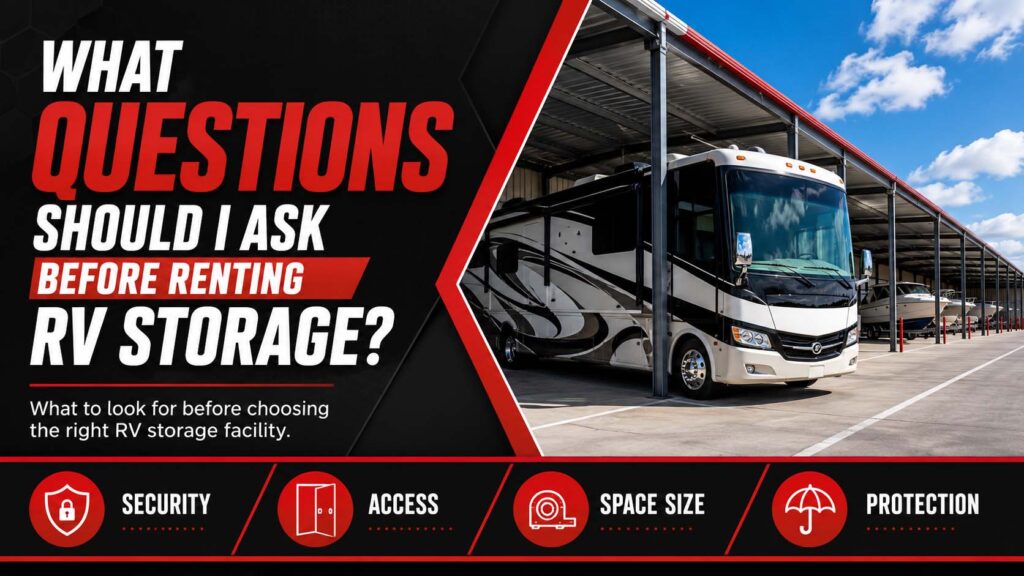
Before renting RV storage, ask about space dimensions, covered versus uncovered parking, security measures, access hours, total monthly costs, rental terms, electrical availability, onsite amenities, and maneuvering room. You should also confirm who is responsible for insurance, whether the facility can accommodate every part of your RV, and how the property is maintained.
These questions matter because RV storage facilities differ significantly. A parking space may appear large enough but fail to account for mirrors, slide-outs, ladders, hitches, air-conditioning units, or safe clearance. An advertised monthly rate may not include required fees, and a convenient location may have access restrictions that interfere with early departures or late returns.
This guide is designed for motorhome, travel trailer, fifth-wheel, camper, and other recreational vehicle owners comparing storage options near San Antonio. It explains the most important questions to ask, common mistakes to avoid, and how to select a facility that fits your vehicle, travel habits, and budget.
Ask an RV storage facility for the exact dimensions of the available space, the total monthly cost, access hours, security features, rental requirements, and whether the parking is covered, uncovered, or enclosed. Confirm that your RV can enter, turn, and park comfortably. You should also ask about electrical access, dump stations, air stations, insurance requirements, maintenance policies, and what happens if you need to change or cancel your rental.
An RV is larger, more complicated, and generally more difficult to store than an ordinary passenger vehicle. It may have an oversized body, roof-mounted equipment, extending mirrors, a tow hitch, slide-outs, a rear ladder, and other components that affect the space it requires.
RV owners also have different storage priorities. A frequent traveler may care most about round-the-clock access and quick highway connections. Someone storing an RV for several months may place greater importance on overhead protection, electrical availability, and routine maintenance access.
Asking detailed questions before signing an agreement helps you:
The following questions can help you evaluate an RV storage facility thoroughly.
Begin by asking for the exact length, width, and height of each available space. Terms such as “small,” “standard,” or “large” are not precise enough to confirm whether your RV will fit.
Measure your RV from its farthest front point to its farthest rear point. Depending on the type of recreational vehicle, this may include:
Do not rely exclusively on the model name or manufacturer’s listed floor-plan length. A travel trailer described as 30 feet long may require a longer space after the hitch, spare tire, and other attachments are included.
Ask whether the stated dimensions describe the physical parking stall or the maximum RV size permitted in that stall. You should also leave enough clearance to park, inspect the vehicle, and reach essential compartments.
The type of storage determines how much protection your RV receives from the outdoor environment.
Uncovered storage is an open parking space. It is often the most affordable option and can work well for owners who use their RV frequently or have a durable exterior cover.
The RV remains exposed to direct sunlight, rain, wind, dust, bird droppings, and falling debris. Regular washing, seal inspections, tire protection, and exterior maintenance are particularly important with this option.
Covered storage provides a roof over the parking space. It can reduce direct exposure to intense sunlight, rain, hail, and debris, although wind and outdoor air can still reach the vehicle.
In San Antonio’s sunny climate, overhead coverage may help reduce continuous UV exposure to the roof, seals, tires, graphics, and exterior finishes. Covered storage is not the same as an enclosed building, but it offers an added layer of protection.
Enclosed storage places the RV within a structure. It typically provides greater separation from outdoor conditions, but availability may be limited and rates are generally higher.
Ask whether the enclosed space is climate-controlled or simply enclosed. These terms are not interchangeable.
An RV fitting within the painted lines does not necessarily mean the space is practical. Ask how much clearance will remain on each side and above the vehicle.
You should be able to enter and leave the space without putting mirrors, awnings, roof equipment, or neighboring vehicles at unnecessary risk. If you need access to exterior compartments while parked, account for the room required to open them.
Ask the facility:
Never open slide-outs or awnings at a storage property unless facility rules expressly allow it and sufficient clearance is available.
The route to the parking space is just as important as the space itself. Large motorhomes, fifth wheels, and travel trailers need adequate turning radius and room to correct their position.
Ask about driveway width, pavement, turning areas, overhead clearance, gate width, and potential obstacles. If possible, tour the property with your RV or use its complete measurements to evaluate the route.
Watch for:
Wide, paved driving areas can make parking easier, especially for owners who are still becoming comfortable backing a trailer.
Ask the storage provider to explain its security measures specifically. The word “secure” is too general to tell you how access is managed or the property is monitored.
Relevant features may include:
No storage facility can guarantee that theft, vandalism, weather damage, or another incident will never occur. Security features can discourage unauthorized activity and help control access, but RV owners should take additional precautions.
Lock exterior compartments, remove portable valuables, close blinds or shades, photograph the RV’s condition, and confirm that your insurance remains effective while the RV is stored.
Ask when you can enter the facility—not simply when the office is open. Office hours and customer gate-access hours are often different.
This is particularly important if you leave before sunrise, return late at night, travel on holidays, or use your RV on short notice. Limited access may create problems even when a facility is close to your home.
Questions to ask include:
Choose access policies that fit the way you actually travel.
Request a complete cost breakdown before comparing RV storage prices. The advertised monthly rate may not include every required charge.
Ask about:
Find out whether the advertised rate is ongoing or introductory. A low initial price may increase after a promotional period, so compare the likely long-term cost instead of only the first month.
The cost of RV storage in San Antonio will vary based on the space size, type of coverage, location, access, amenities, and availability. Contact the facility directly for current pricing rather than relying on an old directory listing.
Some facilities rent month to month, while others may require a minimum term. Ask how long you are committing to the space and whether the agreement renews automatically.
Review:
A month-to-month arrangement can offer flexibility, but you must still provide any notice required by the agreement. Obtain the terms in writing and keep a copy for your records.
Ask whether the facility requires proof of insurance or participation in a tenant-protection program. More importantly, contact your insurance provider and confirm how your existing RV policy applies during storage.
Do not assume that the storage facility’s insurance covers your vehicle. A facility’s policy generally protects the business and property owner; it may not cover a customer’s RV or belongings.
Ask your insurer about coverage for:
Keep photographs, identifying information, accessory records, and an inventory of important contents.
Electrical access can be helpful for maintaining batteries during storage, but it is not available at every space. Ask whether electricity is included, restricted to certain covered stalls, or offered for an additional charge.
Also confirm what type of equipment is permitted. A facility may allow a battery maintainer but prohibit continuous use of air conditioning, heaters, refrigerators, or other appliances.
If electricity is available, ask:
Use only equipment that is suitable for the application and follow both facility policies and manufacturer instructions.
An onsite dump station can make returning from a trip much more convenient. It allows you to empty black- and gray-water tanks before leaving the RV in storage, rather than locating another approved disposal site.
Ask whether the dump station is included for customers, when it can be used, and what procedures must be followed. Never dump wastewater anywhere except an authorized disposal point.
You may also want to ask whether potable or non-potable water is available. Do not assume that water near a dump station is safe for drinking or filling a freshwater tank.
An onsite air station can help owners adjust tire pressure before a trip. This is useful because RV and trailer tires can lose pressure while sitting, especially during temperature changes or extended storage.
Ask whether the air station can accommodate the pressure requirements of your RV’s tires. Tire pressure should be checked when the tires are cold and adjusted according to the vehicle or tire manufacturer’s specifications.
An air station is a useful amenity, but it does not replace regular tire inspections. Check for cracks, bulges, uneven wear, flat spots, embedded objects, and valve-stem problems before traveling.
Storage facilities generally limit the type of work customers may perform onsite. Small inspections may be permitted, while oil changes, engine repairs, washing, generator operation, or extended maintenance may be prohibited.
Ask what you are allowed to do before arriving with tools or service personnel. Relevant questions include:
An RV storage space is not a campsite or repair shop unless the facility explicitly offers those services.
A well-maintained facility can make storing and retrieving an RV easier. Look at pavement condition, drainage, lighting, gates, fencing, landscaping, driving lanes, and common areas.
Ask how the facility handles:
Outdoor and covered storage cannot eliminate dust, insects, rodents, or weather exposure. Owners must still inspect and maintain their vehicles regularly.
San Antonio can experience high temperatures, thunderstorms, strong winds, heavy rain, and occasional freezing conditions. Ask whether the facility has weather-related access policies and how customers receive important notifications.
The storage provider is not responsible for preparing your RV unless the agreement says otherwise. Owners should secure exterior items, close vents and windows, inspect seals, protect tires, and follow the RV manufacturer’s storage recommendations.
Ask whether you may visit the property before or after severe weather and whether access could be temporarily restricted for safety.
Facility rules and insurance policies may restrict what can remain in a stored vehicle. At a minimum, avoid leaving food, perishables, flammable materials, illegal goods, unsecured valuables, or anything likely to attract pests.
Ask specifically about propane systems and other fuel-powered equipment. The facility may have rules concerning tank valves, fuel levels, portable containers, generators, batteries, and hazardous materials.
Before storage:
Following facility policies helps protect your RV and neighboring property.
RV owners sometimes upgrade to a longer motorhome, larger travel trailer, or different type of recreational vehicle. Ask whether you can transfer to another space if your needs change.
A facility cannot guarantee that a larger stall will be available in the future, but understanding the transfer procedure can help you plan. Ask whether a new rental agreement, administrative fee, deposit, or rate will apply.
Never place a larger RV in the existing space without approval. It may block an aisle, extend beyond the parking boundaries, or create inadequate clearance.
A facility tour is one of the most useful steps in the selection process. It allows you to inspect the available space, entrance, turning areas, lighting, driving surface, and relevant amenities.
During the tour, verify:
If an in-person tour is not possible, request current photographs, space dimensions, and a facility map.
Once you know which questions to ask, use this process to compare facilities and prepare for move-in:
Guessing can result in an unusable space. Measure every permanent projection and confirm the facility’s actual dimensions.
The lowest rate may come with limited access, poor maneuvering room, fewer amenities, or inconvenient travel. Compare the complete value and cost.
Covered parking provides overhead protection but remains open to outdoor air and wind-driven weather. Confirm exactly what the storage type includes.
Verbal explanations are helpful, but the written agreement controls the rental relationship. Read it before signing and ask about anything unclear.
The owner is typically responsible for insuring the stored vehicle. Verify coverage directly with your insurance provider.
Food, moisture, low tire pressure, weak batteries, and deteriorated seals can create problems during storage. Complete a storage checklist before move-in.
Storage does not pause deterioration. Visit periodically and look for leaks, pest activity, tire problems, battery issues, or exterior damage.
San Antonio’s heat and strong sunlight can be hard on RV roofs, seals, tires, graphics, dashboards, and interior materials. Covered RV storage can reduce direct sun and rain exposure, although owners must continue performing regular inspections and maintenance.
Heat can also accelerate battery discharge and affect tire pressure. If electrical access is available, a facility-approved battery maintainer may help, but it must be compatible with the battery and allowed under the rental rules.
Strong storms and changing humidity make roof, window, and compartment seals particularly important. Clean the RV before storage, confirm that it is dry, and check for signs of water intrusion after major weather events.
Location matters as well. Driving a large motorhome or towing a trailer through heavy traffic can add time and stress to every trip. Compare the entire route between your home, the storage facility, major highways, fuel stations, campgrounds, and recreational destinations.
The right facility should provide a space that fits your RV, policies that fit your schedule, and clear information about pricing and responsibilities. Staff should be able to answer specific questions about the property rather than relying on vague claims.
Look for:
Do not choose based on one feature alone. A balanced combination of location, space, access, security measures, amenities, service, and cost usually provides the strongest long-term value.
San Antonio RV & Boat Storage provides RV storage for customers in San Antonio and surrounding communities from its Rio Medina location. Available storage options include covered and uncovered parking for RVs, boats, trailers, automobiles, trucks, and other permitted vehicles.
Facility features include wide asphalt driving areas, 24-hour customer access, access control, security lighting, video surveillance, intrusion and beam detection, an automatic air station, and a black- and gray-water dump station. Electrical access suitable for a battery maintainer is available at certain covered spaces.
The facility is convenient to customers traveling from areas such as Alamo Ranch, Helotes, Castroville, Leon Valley, Redbird Ranch, Bandera, and the Medina Lake area. Space availability and rates can change, so RV owners should contact the facility with their complete vehicle dimensions for current information.
RV storage prices depend on space length, location, availability, security features, access, amenities, and whether the parking is uncovered, covered, or enclosed. Larger covered spaces generally cost more than smaller uncovered stalls. Ask for the complete monthly price, including administrative fees, insurance requirements, deposits, and promotional terms. Contact the storage facility directly for current rates and availability.
Measure your RV’s total length, width, and height at its farthest points. Include the hitch, bumpers, mirrors, ladder, spare tire, bicycle rack, air-conditioning units, vents, and other permanent accessories. Choose a space with enough additional clearance to park and access the vehicle safely. If possible, inspect the exact stall and driving route before signing the rental agreement.
Covered RV storage can be worth the additional cost if you want to reduce direct exposure to sunlight, rain, hail, and falling debris. It may be especially valuable for newer RVs, vehicles stored for extended periods, or owners concerned about UV exposure. Covered parking is still open to outdoor temperatures, humidity, dust, and wind, so it does not eliminate routine maintenance.
Access depends on the individual facility’s policies. Some properties restrict customer entry to set hours, while others offer 24-hour gate access. Always distinguish between office hours and customer-access hours. San Antonio RV & Boat Storage provides 24-hour customer access, but customers should still follow all property rules and contact the facility for its current office schedule.
RV storage usually does not include comprehensive insurance for the customer’s vehicle. A facility may require proof of coverage or offer a tenant-protection product, but owners should confirm the details with both the facility and their insurer. Ask whether your policy covers theft, vandalism, storms, fire, personal belongings, and other risks while the RV is stored off your residential property.
Clean and dry the RV, remove food and valuables, empty waste tanks at an approved station, inspect the roof and seals, and adjust tire pressure according to manufacturer specifications. Follow the manufacturer’s recommendations for batteries, fluids, fuel, ventilation, appliances, and long-term storage. Lock all doors and compartments, photograph the vehicle, and return periodically to inspect its condition.
Inspect a stored RV at least periodically and after significant weather events when access is safe. The appropriate schedule depends on the vehicle, storage type, season, battery setup, and manufacturer guidance. Check tire pressure, batteries, seals, covers, moisture, pests, fluid leaks, and visible damage. More frequent inspections may be appropriate during extreme heat or extended periods of non-use.
Generator use depends on the facility’s rules and may be prohibited because of noise, exhaust, fire risk, or customer safety concerns. Ask before operating the generator or engine. Never run either in an enclosed area or where exhaust can affect other people or vehicles. Follow the RV manufacturer’s maintenance schedule and arrange permitted offsite servicing when necessary.
Useful security measures can include controlled gate access, individual entry codes, video surveillance, perimeter protection, intrusion detection, and adequate lighting. No combination of features eliminates every risk, so owners should also lock compartments, remove valuables, document the RV’s condition, and maintain appropriate insurance. Ask the facility to explain its actual systems instead of accepting a general security claim.
Warning signs include unclear rates, vague rental terms, insufficient maneuvering space, damaged gates, poor lighting, standing water, deteriorated pavement, and an inability to confirm space dimensions. Be cautious if you cannot inspect the available stall or receive a written agreement. The facility should also explain access policies, insurance responsibilities, prohibited activities, fees, and security measures clearly.
RV storage facilities generally do not permit customers to live, camp, or sleep in stored vehicles. Storage properties are not campgrounds and may lack the utilities, fire protections, sanitation, and legal authorization required for occupancy. Review the rental agreement and ask about onsite conduct before renting. Use a permitted campground or RV park whenever you need overnight accommodations.
Travel trailers and fifth wheels can generally use appropriately sized RV storage spaces, subject to the facility’s rules and availability. Measure the complete trailer, including its hitch, rear accessories, and maximum height. Confirm that the gate, driveways, and turning areas can accommodate both the trailer and tow vehicle during parking. Fifth wheels may require additional maneuvering room because of their size.
The best RV storage decision begins with accurate measurements and detailed questions. Confirm the type and size of the space, full monthly cost, security measures, customer access, insurance responsibilities, rental terms, maneuvering room, and available amenities before committing.
San Antonio RV & Boat Storage offers covered and uncovered RV storage near San Antonio, along with 24-hour customer access and practical RV amenities. To ask about current availability, pricing, and space sizes, call (210) 245-8616 or complete the facility’s online contact form.
Apartment Living Boat and RV Storage Boat Storage Boat Storage Facility Business Storage Covered RV Storage Decluttering Your Home Downsizing Your Home First-Time First-Time Storage Mistakes Garage Storage journey Locally Owned Storage Facilities Local Storage Facility Long-Term Storage Tips Moving to San Antonio Owner’s Guide Pest Prevention Tips Prepare Your RV Preparing Your RV Prevent Mold & Mildew Protect Your RV Renting Storage Units RV Interior RV products RV Storage RV Storage Cost San Antonio RV San Antonio RV & Boat Storage Self Storage Self Storage for Estate Cleanouts Self Storage Solution Self Storage Solutions storage Storage Renters Storage Solutions for Contractors Storage Tips for Military Families storage unit Storage Units Storage Units for Business Texas weather Tips for First-Time Storage Renters U-Haul Trailer Rentals Ultimate Guide to RV Value of Self Storage
Ready to secure your RV or boat? At San Antonio RV, Boat, and Self Storage, we make booking simple and straightforward. Our clean and secure facilities offer everything you need for your storage needs. Don’t wait any longer—lock in your space now!