Owning a boat makes it easier to enjoy fishing trips, family outings, watersports, and relaxing weekends on the water. However, when the boat is not in use, finding a safe and convenient place to keep it can be challenging—especially if your driveway, garage, neighborhood, or homeowners association has parking restrictions.
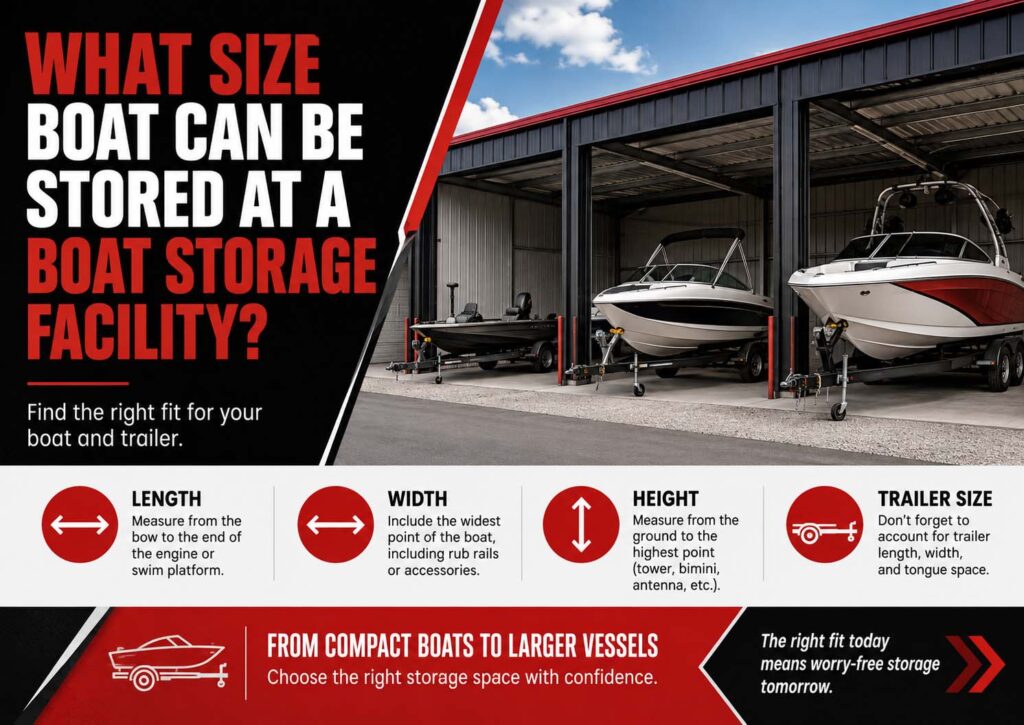
A boat storage facility can provide a practical solution for vessels of many sizes, from personal watercraft and compact fishing boats to larger pontoons, wake boats, and cabin cruisers. The right storage space depends on much more than the boat’s advertised length. You must also account for the trailer, motor, swim platform, tower, windshield, accessories, and the room needed to maneuver safely.
Before renting boat storage in San Antonio, measure the complete boat-and-trailer combination and confirm the facility’s space dimensions, clearance, surface conditions, access policies, and maximum size restrictions.
Most boat storage facilities can accommodate personal watercraft, fishing boats, bass boats, center consoles, ski boats, wake boats, pontoons, deck boats, and some larger cabin cruisers. The exact size that can be stored depends on the facility’s available space lengths, widths, height clearances, turning areas, and rules.
A boat advertised as 22 feet long may require a storage space that is 26 to 30 feet long once its trailer tongue, outboard motor, swim platform, or other accessories are included. Always measure the boat while it is fully loaded on the trailer rather than relying only on the manufacturer’s listed hull length.
For a comfortable fit, select a space slightly longer and wider than your boat-and-trailer combination. If you are considering covered or enclosed boat storage, also measure the vessel’s highest fixed point and confirm the entrance and overhead clearance.
Boat manufacturers generally list a model according to its approximate hull length. That measurement is useful when comparing vessels, but it does not necessarily tell you how much parking space the boat will require.
A complete boat storage measurement may include:
For example, a boat described as a 21-foot model might measure 27 feet from the front of its trailer coupler to the farthest point of the motor. If you rent a 25-foot storage space using only the hull measurement, part of the trailer or motor may extend beyond the assigned area.
This is why accurate measurements are one of the most important steps in choosing boat storage.
Measure the vessel while it is positioned on the trailer exactly as it will be stored. Use a reliable tape measure and record the total length, width, and height.
Begin at the farthest forward point of the trailer, which is usually the trailer coupler. Measure to the farthest point at the back of the boat-and-trailer combination.
The rear measurement may end at:
If the trailer has a folding tongue, measure it both extended and folded. Do not assume the tongue can remain folded during storage without first confirming that the trailer and facility allow it.
Tilt or position the outboard motor according to the way it will be stored. The motor’s angle can change both the overall length and height.
Measure the widest part of the boat or trailer. Depending on the setup, that might include:
The width of the storage space should provide enough room to enter, exit, inspect, cover, and prepare the boat. A space that technically matches the boat’s width may still be difficult to use.
Height is especially important for covered and enclosed storage. Measure from the ground to the highest fixed or normally stored point.
That point may be:
If a component folds down, measure the boat in its storage configuration. Confirm that folding the item will not damage it or interfere with the boat cover.
Remember that overhead clearance can vary across a structure. The lowest beam, doorway, light fixture, gutter, or support may determine whether the boat fits.
Available sizes vary from one facility to another, but most trailered recreational boats fall into several general categories.
Personal watercraft are among the easiest vessels to store. A single Jet Ski or similar watercraft on a trailer may need approximately 10 to 15 feet of length, depending on the model and trailer.
A two-place or three-place personal watercraft trailer may require significantly more width and length.
Suitable storage options may include:
Even with a compact personal watercraft, measure the entire trailer and confirm that the tongue and rear of the vessel remain inside the space.
Small aluminum fishing boats, jon boats, skiffs, and utility boats often range from approximately 10 to 18 feet in hull length. Once placed on a trailer, they may need a space approximately 15 to 23 feet long.
These vessels may be relatively low in height, making them suitable for outdoor, covered, or enclosed storage when the available dimensions permit.
Potential storage complications include:
A lightweight boat can still be longer than expected when all components are included.
Many bass boats fall between approximately 17 and 22 feet in hull length. Their complete storage footprint may reach 22 to 28 feet or more.
Bass boat owners should account for:
Some bass boat trailers have folding tongues, which can reduce the required length. However, the folded tongue does not change the boat’s width or height.
Because bass boats often carry valuable fishing electronics and equipment, owners should also compare facility security features and remove portable valuables before storage.
Center console boats are available in a wide range of sizes. Smaller models may measure 18 to 22 feet, while offshore-capable boats can exceed 30 feet.
A trailered center console may require additional room because of its:
Height is often the deciding factor for covered storage. A T-top that cannot be folded may prevent the boat from fitting under a lower canopy even when the parking space is long enough.
Larger center consoles may also need more turning space because of their total trailer length and tow-vehicle requirements.
Ski boats and wake boats commonly range from approximately 18 to 25 feet, although some models are larger. Their overall trailered length may extend several feet beyond the hull.
Wake boats frequently have towers that increase the height dramatically. Some towers fold, but the folded height must still be measured accurately.
Owners should also include:
A covered space can help reduce direct exposure to the Texas sun, but adequate overhead clearance is essential. Never estimate whether a wake tower will clear a canopy.
Pontoons and tritoons require careful planning because they tend to be both long and wide. Common pontoon boats may range from approximately 18 to 30 feet, with the trailer adding several more feet.
A pontoon’s trailer may also be wider or configured differently from a standard boat trailer.
Consider the total dimensions of:
The tow vehicle and trailer may need a wide turning radius, particularly when backing into an assigned space. Ask whether the facility’s drive aisles can accommodate the complete combination.
Deck boats typically range from about 18 to 28 feet. Their broader design creates more passenger room but can also increase the overall beam.
When measuring a deck boat, include:
A deck boat may fit easily into a long space but still be too wide for a narrow enclosed unit. Confirm all three dimensions before signing a rental agreement.
Some smaller cabin cruisers can be stored at facilities that accommodate large trailered boats. However, they are generally taller and heavier than open recreational boats of a similar length.
Cabin cruisers may have:
The owner must consider the complete length, width, height, weight, and maneuverability of the vessel. The storage facility’s pavement or parking surface must also be appropriate for the load.
Larger cruisers that cannot be transported safely on a standard trailer may require marina storage, dry-stack storage, or another specialized option.
Possibly, but a “30-foot boat” may require considerably more than 30 feet of storage length.
When the trailer tongue, motor, swim platform, anchor system, or other extensions are included, the total footprint could be 35 feet or longer. The trailer and tow vehicle will also need sufficient room to turn, align, and back into the space.
Before attempting to store a boat of this size, ask the facility:
Never reserve a space for a larger vessel based only on a verbal description such as “large boat parking.” Request the exact dimensions.
Yes. A boat may be unsuitable for a particular facility if it exceeds the available parking dimensions, gate clearance, drive-aisle width, surface capacity, or turning radius.
A vessel may also be too large if:
When a trailered boat becomes too large for conventional storage, alternatives may include a marina slip, boatyard, dry-stack storage facility, or specialized oversized-vehicle storage property.
A storage space should generally be longer than the complete boat-and-trailer measurement. The appropriate allowance depends on the storage type and facility layout.
Extra room makes it easier to:
For an outdoor space, a small amount of additional length may be sufficient if the drive aisle is wide and the entire rig remains within the markings. Covered and enclosed spaces often require more careful clearance calculations.
Ask the facility how much additional room it recommends for a boat of your measured dimensions.
The size of the boat is only one factor. Owners must also decide which storage type offers the right combination of space, protection, convenience, and price.
Outdoor parking often accommodates the widest range of boat lengths and heights. It can be a practical choice for large center consoles, pontoons, wake boats, and other vessels that may not fit under a canopy.
Potential benefits include:
The boat remains exposed to sunlight, heat, rain, hail, wind, dust, and debris. A properly fitted marine cover and regular inspections can help protect it.
Covered storage provides overhead protection and may reduce direct exposure to the Texas sun, rain, hail, and falling debris.
It can be particularly helpful for protecting:
The primary limitation is height. Measure towers, T-tops, hardtops, windshields, antennas, and other accessories before renting.
Covered storage is not fully enclosed and may still allow exposure to wind-driven rain, dust, humidity, pests, and angled sunlight.
Enclosed storage provides separation from outdoor conditions and may offer additional privacy. However, availability and dimensions can be more limited.
The door opening must be wider and taller than the vessel, but that alone is not enough. The interior must also accommodate the full trailer length and allow room to close the door.
Ask whether the unit is:
Do not assume an enclosed unit is climate-controlled unless the facility specifically confirms it.
A storage space can be technically large enough but still be difficult to use. Boat trailers respond differently from the tow vehicle when reversing, and longer trailers require wider turns.
Before renting, consider:
If possible, visit the facility with the tow vehicle and boat before signing the agreement. If that is not practical, provide the facility with the full measurements and ask about the recommended approach.
A few extra feet of space can make the difference between easy access and a stressful parking experience.
Yes. At conventional outdoor, covered, or enclosed boat storage facilities, the boat is generally kept on its trailer. The complete trailer must fit inside the assigned area.
The facility may require the trailer to be:
The trailer tongue cannot block an aisle, neighboring space, doorway, or emergency access route. Ask whether wheel chocks, hitch locks, jack stands, or other equipment are permitted.
Size is important, but it should not be the only consideration.
Ask about features such as gated entry, fencing, lighting, video surveillance, and on-site management. No security system eliminates all risk, so owners should maintain insurance and remove portable valuables.
Confirm when you can retrieve or return the boat. Early-morning anglers and weekend boaters may need access outside conventional office hours.
A stable, well-maintained surface helps reduce mud, sinking, standing water, and trailer instability. Examine drainage conditions, particularly in areas that experience heavy rain.
A convenient facility can reduce travel time and make it easier to inspect the boat. Consider its distance from your home, major roads, fuel stations, service providers, and preferred lakes or launch points.
Ask about restrictions concerning:
Clear rules help prevent misunderstandings after the rental begins.
Once you find the correct space, prepare the boat to reduce damage while it is parked.
Remove dirt, salt, plant material, fish residue, food, and standing water. Allow compartments, livewells, coolers, and upholstery to dry.
Follow the engine manufacturer’s instructions for flushing, fuel treatment, lubrication, battery care, and long-term storage.
Take home portable electronics, fishing equipment, documents, keys, and personal belongings whenever possible.
Choose a fitted, breathable marine cover designed for the boat. Secure it carefully so it does not flap, pool water, or rub against the finish.
Check tire pressure, tread condition, bearings, lights, brakes, hitch components, and the spare tire. Trailer tires can deteriorate while sitting, particularly in strong Texas sunlight.
Follow the battery and boat manufacturer’s recommendations. Remove, disconnect, or use an approved maintenance system when appropriate.
Check for moisture, mold, pests, low tires, cover damage, battery problems, leaks, or storm damage. Visit after severe weather whenever it is safe to do so.
Before choosing a facility, ask:
Providing accurate measurements allows the facility to recommend a more appropriate space.
A 20-foot boat may need a space approximately 24 to 28 feet long after accounting for its trailer tongue, engine, swim platform, and accessories. Measure the complete rig to determine the actual requirement.
It might, but only if the entire boat-and-trailer combination is less than 25 feet. Many 21-foot boats exceed that length when the trailer and motor are included.
Some pontoons fit in covered storage, but their width, trailer height, bimini top, and overall length must be checked. Confirm the lowest overhead clearance and usable space width.
Yes, if the facility has enough height. Measure the tower in its normal storage position. If it folds, measure the folded height and make sure all speakers, racks, and bimini components are included.
Many facilities require every part of the boat and trailer to remain inside the assigned space. Ask about the rule before renting. Extending into an aisle may create a safety hazard.
Measure it in the position in which it will be stored. If you are uncertain, measure both configurations and use the larger dimensions when discussing the space with the facility.
That depends on the facility’s rules and the width of the space. Loose equipment may create safety, security, and access problems. Ask before leaving items outside the boat.
Covered storage can help reduce direct exposure to intense sunlight, heat, rain, hail, and debris. It does not eliminate the need for a fitted boat cover, maintenance, insurance, and regular inspections.
If you expect to upgrade soon, consider renting a larger space when one is available. This may prevent the inconvenience of transferring to another space later.
Boat storage facilities can accommodate many types and sizes of vessels, but the right fit depends on the boat’s complete dimensions—not simply the length printed on its model description.
Measure from the trailer coupler to the farthest rear component, identify the widest point, and measure from the ground to the highest fixed accessory. Then add enough room for safe parking, access, inspection, and retrieval.
When comparing boat storage in San Antonio, consider the space dimensions, overhead clearance, turning areas, access hours, parking surface, drainage, security features, and available storage options. Taking the time to choose an appropriate space can make every future trip to the water easier.
San Antonio RV & Boat Storage provides convenient storage solutions for local boat owners. Contact the facility with your complete boat-and-trailer measurements to ask about current availability, space dimensions, access policies, and rental requirements.
Need boat storage in San Antonio? Contact San Antonio RV & Boat Storage today to find a space that accommodates your vessel, trailer, and boating lifestyle.
Apartment Living Boat and RV Storage Boat Storage Boat Storage Facility Business Storage Covered RV Storage Decluttering Your Home Downsizing Your Home First-Time First-Time Storage Mistakes Garage Storage journey Locally Owned Storage Facilities Local Storage Facility Long-Term Storage Tips Moving to San Antonio Owner’s Guide Pest Prevention Tips Prepare Your RV Preparing Your RV Prevent Mold & Mildew Protect Your RV Renting Storage Units RV Interior RV products RV Storage RV Storage Cost San Antonio RV San Antonio RV & Boat Storage Self Storage Self Storage for Estate Cleanouts Self Storage Solution Self Storage Solutions storage Storage Renters Storage Solutions for Contractors Storage Tips for Military Families storage unit Storage Units Storage Units for Business Texas weather Tips for First-Time Storage Renters U-Haul Trailer Rentals Ultimate Guide to RV Value of Self Storage
Ready to secure your RV or boat? At San Antonio RV, Boat, and Self Storage, we make booking simple and straightforward. Our clean and secure facilities offer everything you need for your storage needs. Don’t wait any longer—lock in your space now!