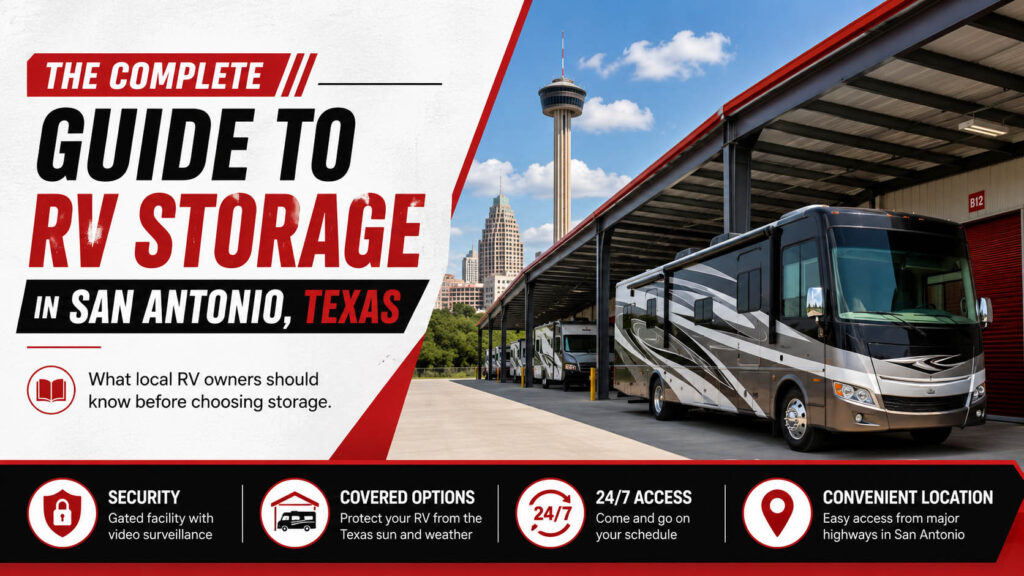
Owning an RV gives you the freedom to explore Texas, visit national parks, take spontaneous weekend trips, and enjoy extended vacations without giving up the comforts of home. However, when your RV is not on the road, you need a dependable place to keep it protected, accessible, and ready for your next adventure.
For many owners, parking an RV at home is not practical. Driveways may be too short, neighborhood rules may prohibit recreational vehicles, and exposure to the intense San Antonio sun can damage an RV’s exterior, tires, seals, and interior. Professional RV storage offers a convenient alternative that can help protect your investment while freeing up valuable space at home.
This complete guide explains what to look for in RV storage in San Antonio, the differences between available storage options, how to determine the right space size, and how to prepare your recreational vehicle for storage.
The best way to store an RV in San Antonio is at a conveniently located facility that offers spaces large enough for your vehicle, secure property access, adequate maneuvering room, and the level of weather protection you prefer.
Covered RV storage is especially valuable in South Texas because it helps reduce direct exposure to intense sunlight, heat, hail, rain, and falling debris. Before renting a space, measure your RV’s complete length, width, and height, including all permanently attached accessories. You should also ask about access hours, security features, lease terms, electrical availability, and facility rules.
San Antonio’s location makes it an excellent home base for RV owners. From the Texas Hill Country and Gulf Coast to state parks and lakes throughout South and Central Texas, there are countless destinations within a few hours of the city.
The same climate that allows for year-round travel can create storage challenges. San Antonio RV owners must consider prolonged sunlight, high summer temperatures, sudden storms, humidity, wind, and occasional freezing conditions.
A professional RV storage facility can provide several important benefits:
RV storage is not simply about finding an empty parking space. It is about selecting an appropriate environment for a valuable vehicle that may represent a significant financial and personal investment.
Texas weather can be hard on recreational vehicles, especially when they remain parked outdoors for weeks or months.
San Antonio summers regularly bring high temperatures and extended periods of direct sunlight. The surface temperature of an RV can become substantially hotter than the surrounding air, especially on a dark roof or sidewall.
Over time, ultraviolet exposure can contribute to:
Covered storage does not eliminate the heat, but it can reduce direct solar exposure and help protect sensitive exterior components.
Thunderstorms can develop quickly across South Texas. High winds, heavy rain, and hail can damage roof vents, air-conditioning units, skylights, windows, awnings, and exterior panels.
No storage arrangement can guarantee complete protection from every storm. However, a sturdy overhead covering may reduce exposure to hail, branches, and windblown debris.
Moisture can enter an RV through worn seals, roof damage, plumbing issues, or inadequate ventilation. Once inside, it can create conditions that encourage mold, mildew, corrosion, and unpleasant odors.
Regular inspections and proper ventilation are essential whether the RV is stored inside, under a canopy, or outdoors.
San Antonio is known for heat, but freezing conditions are still possible. RV plumbing systems can be damaged when water freezes and expands inside pipes, tanks, filters, or fixtures.
If the RV will remain unused during winter, owners should monitor forecasts and winterize the plumbing system when appropriate.
Not every RV owner needs the same level of protection. Your ideal choice will depend on your budget, RV size, frequency of use, and comfort with exposure to the weather.
Outdoor storage generally consists of a designated parking space within a storage facility. It is often the most economical option and may accommodate a wide range of RV sizes.
Potential advantages include:
The primary disadvantage is exposure to sunlight, rain, hail, and debris. An RV cover may offer additional protection, but it must fit properly and be secured to prevent movement in strong winds.
Covered RV storage provides a roof or canopy over the parking space. Some structures are open on the sides, while others may offer partial side protection.
For many San Antonio RV owners, covered storage provides a practical balance between affordability and weather protection. It can help shield the roof and upper surfaces from direct sunlight, rain, hail, and falling debris.
Benefits may include:
Because covered spaces have height restrictions, owners must confirm that the roof, air-conditioning unit, satellite equipment, antennas, and other accessories will clear the structure.
Enclosed storage places the entire RV inside a private unit or building. It offers the greatest separation from weather, sunlight, and public view.
Possible advantages include:
Enclosed units are usually more expensive and may have strict door height, width, and length limitations. They can also be difficult to find for very large motorhomes or fifth wheels.
Choosing the correct space begins with accurate measurements. Do not rely exclusively on the RV’s model name, floor plan, or advertised body length.
Measure the RV’s total dimensions as it will be stored.
Include permanently attached components such as:
A trailer marketed as 30 feet long may require a space longer than 30 feet once the tongue, bumper, and accessories are included.
Height is especially important for covered and enclosed spaces. Measure from the ground to the highest fixed point, which may be an air-conditioning unit, vent cover, antenna, satellite dish, or roof rack.
Remember that suspension changes, tire pressure, or uneven pavement can affect clearance. Allowing extra space is safer than selecting a canopy that barely fits.
Most RVs fit within standard storage-space widths, but slide-outs, awnings, mirrors, doors, and steps require additional consideration. Slide-outs and awnings are generally retracted during storage, but you may need enough room to open a door or access a compartment.
The size of the parking space is only part of the equation. Consider how easily you can approach, turn, reverse, and leave.
Large motorhomes, travel trailers, and fifth wheels require wider drive aisles and generous turning space. A space that technically fits the RV may still be inconvenient if the surrounding layout is too tight.
Price matters, but it should not be the only consideration. Evaluate the facility as a complete storage environment.
Ask how customers enter the property and whether access is restricted to authorized tenants. Controlled gates and individualized access methods can help limit unnecessary traffic.
You should also ask about access hours. Some owners need early-morning or evening access when preparing for a trip.
Good property lighting supports visibility when parking, inspecting, or retrieving an RV. This is especially helpful during shorter winter days or when returning from a trip after sunset.
Cameras can provide an additional layer of property monitoring. Ask which parts of the facility are covered, whether footage is recorded, and how long recordings are retained.
Surveillance should be considered one part of a broader security strategy rather than a guarantee against theft or damage.
A well-defined perimeter can help discourage unauthorized entry. When visiting a facility, look at the condition of the fencing, gates, entrances, and surrounding property.
Adequate maneuvering space can make a substantial difference, especially if you own a large travel trailer or fifth wheel. If possible, visit the facility with your tow vehicle before renting a space.
The parking surface should provide dependable support for a heavy recreational vehicle. Ask whether the spaces are paved, concrete, gravel, or another stabilized material.
Good drainage is also important. Standing water and soft ground can make parking difficult and expose the underside of the RV to prolonged moisture.
Some facilities offer electrical connections that may be used for battery maintenance or other approved purposes. Never assume that electricity is included.
Ask about:
Follow both facility policies and the manufacturer’s recommendations.
RV storage prices vary according to the size of the space, level of protection, location, amenities, demand, and lease terms.
Outdoor spaces are generally the least expensive. Covered spaces typically cost more because of the added structure and weather protection. Enclosed storage is often the most expensive option.
Other factors that may affect the monthly rate include:
When comparing prices, confirm exactly what is included. A slightly higher monthly rate may provide greater convenience, a better location, easier maneuvering, or more suitable protection for your RV.
A conveniently located facility can make RV ownership much easier. If storage is far from your home or normal travel route, preparing for trips may become unnecessarily time-consuming.
Consider proximity to:
For San Antonio-area travelers, access to major routes can help simplify departures toward the Hill Country, Austin, the Gulf Coast, West Texas, or destinations farther north.
The closest facility is not always the best choice, but convenience should be part of your decision.
Proper preparation helps prevent unpleasant surprises when you return. Your process should reflect the RV manufacturer’s instructions, the season, and the anticipated storage period.
Remove food, crumbs, open beverages, and anything likely to attract pests. Clean countertops, floors, cabinets, the refrigerator, and cooking areas.
Avoid leaving perishable or heat-sensitive products inside. San Antonio temperatures can become extremely high in a closed RV.
Turn the refrigerator off according to the manufacturer’s instructions. Remove all food, wipe down the interior, and leave the doors slightly open when appropriate to help prevent odors and mildew.
Check the roof, windows, doors, vents, skylights, and exterior seams. Repair deteriorated sealant before storage rather than waiting for the next storm to reveal a leak.
Inflate the tires to the manufacturer-recommended pressure and inspect them for cracking, uneven wear, or damage. Long-term exposure to sunlight can accelerate tire deterioration, so tire covers may be helpful in outdoor or partially covered spaces.
Do not use improvised supports or lift the RV unless the manufacturer specifically recommends an approved procedure.
Battery-maintenance requirements vary by RV type and battery chemistry. Depending on the system, you may need to disconnect, remove, charge, or maintain the batteries.
Consult the owner’s manual or a qualified RV technician. Incorrect charging or storage can damage batteries and create safety risks.
If freezing weather is possible, protect freshwater lines, tanks, filters, pumps, water heaters, and fixtures. Winterization requirements vary, so follow the instructions for your specific RV.
Retract awnings and slide-outs unless the manufacturer provides different storage guidance. Leaving them extended creates additional exposure and may strain mechanical components or seals.
Turn off propane appliances and follow all facility rules regarding propane cylinders, fuel, and hazardous materials. Some facilities may have specific restrictions that must be followed.
Take dated photographs of the exterior and interior before leaving the RV. This creates a helpful record of its condition and reminds you how it was stored.
A fitted RV cover can provide additional protection from sunlight, dust, and debris, especially in an uncovered space. However, not every cover is appropriate for every RV or climate.
A poorly fitted cover may flap in the wind, rub against painted surfaces, trap moisture, or tear around sharp accessories. If you use one, select a breathable cover designed for your RV type and secure it according to the manufacturer’s directions.
Avoid using a basic plastic tarp as a long-term substitute. Tarps may trap moisture and create abrasive movement against the exterior.
Even a well-prepared RV should not be ignored for months. Regular inspections can help you catch small problems before they become expensive repairs.
During each visit, check:
You may need to inspect more frequently after hail, heavy rain, high winds, freezing weather, or extreme heat.
Before signing an agreement, ask the facility manager:
Read the rental agreement carefully. Understanding the rules before moving in can help prevent misunderstandings later.
One of the most common mistakes is renting a space without taking complete measurements. Other problems often result from rushed preparation or long periods without inspections.
Avoid these errors:
A short preparation checklist can save time and reduce the risk of preventable damage.
For many local RV owners, covered storage is worth considering because of San Antonio’s intense sunlight, high temperatures, and severe-weather potential.
The roof is one of the most vulnerable and expensive parts of an RV. It contains seams, vents, air-conditioning equipment, skylights, antennas, and other components that can deteriorate through prolonged exposure.
Covered storage may help:
Covered storage cannot prevent every type of damage, and the RV still requires regular maintenance. Nevertheless, it can provide a valuable additional layer of protection.
The right storage facility should fit your vehicle, travel habits, preferred level of protection, and budget. Begin by measuring your RV, deciding whether you want outdoor, covered, or enclosed storage, and identifying the locations that are most convenient for your typical routes.
Visit the facility before renting when possible. Look at the parking surface, drive aisles, lighting, gates, drainage, and overall condition of the property. Imagine arriving with your RV attached to your tow vehicle and consider whether you would feel comfortable maneuvering through the facility.
San Antonio RV & Boat Storage provides a convenient option for owners looking for dedicated recreational vehicle storage in the San Antonio area. Contact the facility directly to discuss current space availability, dimensions, features, access policies, and pricing.
Your RV makes it possible to experience new places, spend time with family, and enjoy the freedom of the open road. Choosing appropriate storage helps protect that experience between trips.
By selecting the right space, preparing your RV carefully, and inspecting it regularly, you can reduce unnecessary wear and keep your vehicle ready for its next destination.
If you are searching for RV storage in San Antonio, contact San Antonio RV & Boat Storage to learn more about available spaces. Discuss your RV’s total dimensions and storage needs with the team so you can choose an option that offers the space, access, and protection your recreational vehicle deserves.
Apartment Living Boat and RV Storage Boat Storage Boat Storage Facility Business Storage Covered RV Storage Decluttering Your Home Downsizing Your Home First-Time First-Time Storage Mistakes Garage Storage journey Locally Owned Storage Facilities Local Storage Facility Long-Term Storage Tips Moving to San Antonio Owner’s Guide Pest Prevention Tips Prepare Your RV Preparing Your RV Prevent Mold & Mildew Protect Your RV Renting Storage Units RV Interior RV products RV Storage RV Storage Cost San Antonio RV San Antonio RV & Boat Storage Self Storage Self Storage for Estate Cleanouts Self Storage Solution Self Storage Solutions storage Storage Renters Storage Solutions for Contractors Storage Tips for Military Families storage unit Storage Units Storage Units for Business Texas weather Tips for First-Time Storage Renters U-Haul Trailer Rentals Ultimate Guide to RV Value of Self Storage
Ready to secure your RV or boat? At San Antonio RV, Boat, and Self Storage, we make booking simple and straightforward. Our clean and secure facilities offer everything you need for your storage needs. Don’t wait any longer—lock in your space now!