Owning a boat gives you the freedom to enjoy early-morning fishing trips, relaxing weekends with family, and memorable days on the water. But before every outing begins, you must transport, prepare, launch, retrieve, and store your boat.
Where you store it can make that process either easier or much more complicated.
Many San Antonio boat owners face the same decision: Is it better to choose boat storage close to home or near the lake?
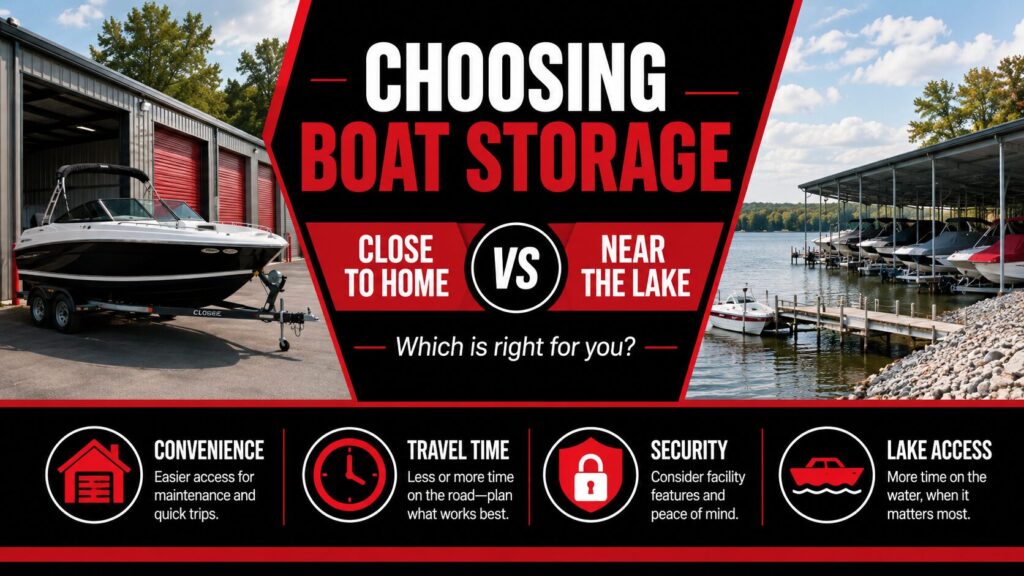
Boat storage near home makes it convenient to check the vessel, load supplies, perform maintenance, and prepare before a trip. Storage near the lake can reduce towing time, fuel use, and the frustration of pulling a trailer through city traffic.
Neither option is automatically right for every boat owner. The best location depends on where you live, which lake you use most often, how frequently you go boating, and how much preparation you complete at home.
This guide compares the advantages and disadvantages of both choices so you can find a boat storage location that fits your routine, protects your investment, and helps you spend more time on the water.
The best storage location is usually the one that removes the most inconvenience from your normal boating routine.
Choose boat storage close to home when you want quick access for maintenance, cleaning, loading, or frequent inspections. Choose storage near the lake when you want to reduce long-distance towing and usually visit the same body of water.
A third option may provide the best balance: a facility located between your home and your preferred lake. This arrangement can give you convenient access from the city without requiring you to tow your boat through as much traffic.
Before choosing a facility, ask yourself:
Distance matters, but it should not be the only consideration. A facility five minutes closer may not be the better choice if it has narrow roads, restricted access hours, insufficient security, or no space that properly fits your boat and trailer.
Storing your boat near home can be highly convenient, particularly if you perform much of your preparation and maintenance yourself.
Instead of making a special trip across town, you can stop by the facility before work, after dinner, or whenever your schedule allows. This flexibility can make it easier to keep the boat ready for your next adventure.
Boats and trailers need regular attention, even when they are not being used. A nearby storage facility makes it easier to check:
Regular inspections can help you identify minor issues before they become expensive repairs or cause delays on departure day.
If your boat is stored far from home, you may be more likely to postpone these checks. A nearby facility can encourage a more consistent maintenance schedule.
Many boat owners carry more than the boat itself. A typical lake trip might include:
When your boat is stored close to home, you may be able to load these items shortly before leaving. You can also return valuable equipment to your house after the trip rather than leaving it in the boat.
This can be especially useful for families who need to coordinate several people and a large amount of gear.
San Antonio weather can create unexpected opportunities for a day on the water. If your boat is nearby, a last-minute decision may be easier to turn into an actual outing.
You can retrieve the boat, load your supplies, and leave without first driving a long distance in the opposite direction.
Nearby storage may work well for owners who:
If facility rules and your property allow it, storing near home may make it more practical to bring the boat home temporarily for detailed cleaning, maintenance, or packing.
You may prefer access to your own tools, water supply, electrical outlets, and cleaning products. After the work is complete, you can return the boat to storage without making a long trip.
Boat storage near home may simplify preparation, but it does not necessarily simplify the complete trip.
If your house is far from the lake, you may have to tow your boat across San Antonio every time you go boating. That can mean:
Towing a long pontoon, wake boat, cabin cruiser, or offshore fishing boat can be stressful in congested areas. Even an experienced driver may prefer to reduce the amount of urban towing required.
Towing increases fuel consumption. If you travel a long distance between your storage facility and the lake, the additional fuel expense can become significant over an entire boating season.
The impact depends on:
A storage space near home may appear convenient, but repeatedly towing across the city could make it less economical overall.
The drive home can feel especially long after a full day of boating. You still need to retrieve the boat from the water, secure it to the trailer, confirm that the lights work, transport it back through traffic, and park it safely.
When storage is far from the lake, a relaxing day can end with a difficult return trip.
Boat storage near the lake is an appealing choice for owners who usually visit the same destination. It can shorten the portion of the journey during which the boat is attached to the tow vehicle.
This is often the biggest advantage. You may still need to drive from your home to the storage facility, but you will travel most of that distance without a trailer.
Once you reach the facility, you can connect the boat and make the shorter trip to the launch ramp.
Less towing may mean:
The convenience can be especially valuable for large or heavy boats.
When your boat is stored close to the lake, you may be able to arrive at the ramp earlier and spend less of the day transporting the vessel.
This is helpful when:
If your boat is already clean, fueled, charged, and stocked with essential equipment, lake-area storage can make departure surprisingly simple.
Anglers often want to be on the water before sunrise. A facility near the lake can reduce the time spent towing in the dark and make it easier to reach the launch before peak activity.
However, this advantage depends on access hours. A storage property near the lake is not particularly useful for an early departure if the gate does not open until later in the morning.
Look for a facility offering 24/7 customer access so your storage schedule does not control your fishing schedule.
A lake day does not always end on time. Weather, crowds at the ramp, mechanical issues, and changing plans can delay your return.
Storing close to the lake allows you to secure the boat without towing it all the way across San Antonio after dark. Once the boat is parked, you can drive home without the trailer attached.
Towing places additional demand on the engine, transmission, brakes, tires, and suspension. Reducing the distance traveled with a heavy trailer may help reduce wear over time.
The trailer may also experience less tire wear, bearing wear, and road exposure. Proper maintenance remains essential, but shorter towing distances can simplify ownership.
Lake-area storage offers meaningful convenience, but it is not the right choice for every owner.
If the facility is a long drive from home, checking the boat may require a dedicated trip. Minor tasks that would be easy at a nearby facility can become inconvenient.
You may be less likely to visit just to:
If you choose lake-area storage, create a regular inspection schedule rather than relying only on boating days.
You will need to remember everything before leaving home. Discovering that you forgot fishing equipment, a boat key, life jackets, or a child’s gear becomes more frustrating when the boat and your supplies are located far apart.
A checklist can help you organize each trip. Keeping approved basic equipment securely aboard the vessel may also reduce the number of items you must transport from home.
Storage near one lake makes the most sense when that is your regular destination. If you alternate between Medina Lake, Canyon Lake, Lake LBJ, the coast, and other locations, a facility near one body of water may not always reduce travel time.
A centrally positioned storage facility may provide greater flexibility for boat owners who explore several destinations.
A rural or lake-area location should not be assumed to offer better security simply because it is outside a busy city.
Evaluate the property’s actual safeguards, including:
No storage facility can guarantee that an incident will never occur. However, layered security can help deter unauthorized access and give owners greater confidence.
How often you use your boat should influence where you store it.
If you launch several times a month at the same lake, near-lake storage may save substantial towing time throughout the year. The benefits accumulate with every trip.
If you use the boat only occasionally, close-to-home storage may be more practical. You can inspect and maintain it regularly without driving to the lake when you are not actually boating.
Consider these general scenarios:
| Boating habit | Location that may be more convenient |
|---|---|
| Frequent trips to one lake | Near the lake |
| Trips to several different lakes | Close to home or along a central route |
| Frequent maintenance and upgrades | Close to home |
| Large boat that is difficult to tow | Near the lake |
| Spontaneous destination changes | Close to home |
| Early-morning fishing at one lake | Near the lake with 24/7 access |
| Occasional seasonal use | Close to home or the best-value secure facility |
| Home located along the route to the lake | Between home and the lake |
This is only a starting point. The best solution depends on the complete route and the quality of the available facilities.
A storage facility may appear close on a map but still be inconvenient if reaching it requires congested roads, construction zones, complicated turns, or traveling away from your destination.
Before renting, drive the complete route during the hours when you normally go boating.
Evaluate:
The most useful question is not simply, “How many miles away is the facility?” Instead, ask, “How easy is it to include this facility in my normal boating trip?”
A storage property located on the way to the lake may be more convenient than one geographically closer to your house but in the opposite direction.
The savings depend on how far you would otherwise tow the boat.
Imagine that one facility requires 30 miles of towing each way, while another reduces the boat-and-trailer portion of the trip to 10 miles each way. The near-lake option removes 40 miles of towing from every outing.
Over 20 boating trips, that equals 800 fewer towing miles.
Potential benefits include:
However, remember that you still must drive your tow vehicle to the storage facility. Near-lake storage generally reduces towing miles, not necessarily every mile driven.
Compare the complete cost rather than only the monthly rent. A slightly higher storage rate could still provide better value if it consistently saves fuel, time, and vehicle wear.
After selecting the general location, decide whether you need uncovered, covered, or enclosed storage.
Uncovered parking is generally the most affordable option and may accommodate taller boats with towers, T-tops, or antennas.
The boat remains exposed to San Antonio’s sunlight, heat, rain, wind, dust, and hail. A breathable, properly fitted cover can help protect the interior, but regular inspections are still necessary.
Covered boat storage provides overhead protection and can reduce direct exposure to sunlight and rain. This can help protect:
Confirm the structure’s height and width before renting. Measure the boat on its trailer, including the tower, Bimini top, antennas, motor, guide posts, and other accessories.
Enclosed storage offers walls, a roof, and a door. It provides greater separation from weather, dust, pests, and casual visibility.
However, enclosed spaces usually have more restrictive length, width, and height requirements. Door clearance may be lower than the interior ceiling.
The right facility should make your boating routine safer and more convenient. Compare the following before making a decision.
Measure the entire boat-and-trailer combination—not just the hull.
Include:
Allow enough extra room to hitch, unhitch, inspect the trailer, and avoid contact with posts, fences, or neighboring vehicles.
Wide roads and generous turning areas are particularly important for pontoons, wake boats, center consoles, cabin cruisers, and tandem-axle trailers.
Tour the facility with your tow vehicle and boat if possible. A space may be large enough while the roads leading to it are too narrow for comfortable backing.
If you fish before sunrise or return after dark, restricted access can become a major inconvenience. A facility offering 24/7 customer access gives you greater control over your schedule.
Look for multiple security measures instead of relying on a single gate or camera. Controlled access, video surveillance, lighting, perimeter protection, and intrusion detection can contribute to a stronger overall system.
A paved, well-drained facility can make parking, hitching, and inspecting your boat easier. It may also reduce mud, deep ruts, standing water, and dust around the vessel.
Ask what may remain in the boat and whether the facility has rules concerning:
Understanding the rules before move-in can prevent surprises later.
For many San Antonio boat owners, the best option is not directly beside the house or directly beside the launch ramp. A facility located along the route to the lake may provide the advantages of both.
You can drive from home without towing the boat, retrieve it on the way to your destination, and complete only the final portion of the trip with the trailer attached.
This arrangement may offer:
San Antonio RV & Boat Storage is located near the Alamo Ranch area and approximately 10 minutes from Medina Lake. This location can be particularly convenient for boat owners in western San Antonio and surrounding communities who want city accessibility without storing their boat far from the water.
Before signing a rental agreement, ask:
A facility tour can reveal practical issues that are difficult to identify online. Pay attention to the gate width, aisle layout, turning radius, surface condition, lighting, and distance from the storage space to the exit.
Boat storage near home is usually better for frequent maintenance, loading, and inspections. Storage near the lake is often better for reducing towing time, fuel consumption, and traffic-related stress. The right option depends on your normal boating route.
It can be worthwhile if you frequently use the same lake, tow a large boat, or want to reduce the distance traveled with a trailer. Compare the monthly cost with the potential savings in time, fuel, and vehicle wear.
Occasional boaters may benefit from storage near home because they can inspect and maintain the boat without making a special trip toward the lake. However, facility quality and security should remain priorities.
A centrally located facility or one near your most commonly traveled highway may provide greater flexibility. Storage directly beside one lake may be less convenient when traveling elsewhere.
There is no ideal distance for every owner. Focus on towing time, traffic, road conditions, launch-ramp access, and facility features. A property 10 to 20 minutes from the lake may offer a useful balance.
Covered storage can help reduce direct exposure to intense Texas sunlight, heat, rain, and some falling debris. It may be especially valuable for protecting upholstery, finishes, tires, covers, and other weather-sensitive components.
Choosing between boat storage close to home and storage near the lake comes down to how you use your boat.
If you prioritize maintenance access, loading convenience, and destination flexibility, storing near home may be the better choice. If you frequently visit the same lake and want to reduce towing time, fuel use, and traffic stress, near-lake storage may provide greater value.
For many owners, a facility positioned between home and the water offers the ideal balance.
San Antonio RV & Boat Storage provides covered and uncovered boat storage near Alamo Ranch and approximately 10 minutes from Medina Lake. Facility features include:
Your boat storage location should make ownership easier—not add another obstacle to every trip. Consider the entire journey, including preparation, towing, launching, returning, maintenance, and access.
Call San Antonio RV & Boat Storage at (210) 245-8616 to discuss your boat’s dimensions, check current space availability, or schedule a facility tour.
Apartment Living Boat and RV Storage Boat Storage Boat Storage Facility Business Storage Covered RV Storage Decluttering Your Home Downsizing Your Home First-Time First-Time Storage Mistakes Garage Storage journey Locally Owned Storage Facilities Local Storage Facility Long-Term Storage Tips Moving to San Antonio Owner’s Guide Pest Prevention Tips Prepare Your RV Preparing Your RV Prevent Mold & Mildew Protect Your RV Renting Storage Units RV Interior RV products RV Storage RV Storage Cost San Antonio RV San Antonio RV & Boat Storage Self Storage Self Storage for Estate Cleanouts Self Storage Solution Self Storage Solutions storage Storage Renters Storage Solutions for Contractors Storage Tips for Military Families storage unit Storage Units Storage Units for Business Texas weather Tips for First-Time Storage Renters U-Haul Trailer Rentals Ultimate Guide to RV Value of Self Storage
Ready to secure your RV or boat? At San Antonio RV, Boat, and Self Storage, we make booking simple and straightforward. Our clean and secure facilities offer everything you need for your storage needs. Don’t wait any longer—lock in your space now!